M203 20260502 Counting and Probability (Part 1)
#Bijection
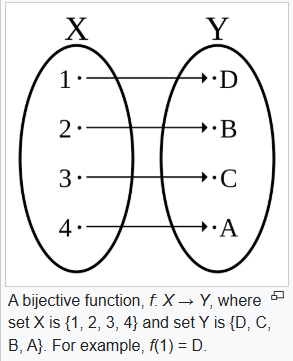
In mathematics, a bijection, bijective function, or one-to-one correspondence is a function between two sets such that each element of the second set (the codomain) is the image of exactly one element of the first set (the domain). Given a function $f: A \to B$, the image of an element $a \in A$ is the element $f(a) \in B$ in the codomain. The pre-image of an element $b \in B$ is any element $a \in A$ in the domain such that $f(a) = b$. Equivalently, a bijection is a relation between two sets such that each element of either set is paired with exactly one element of the other set.
A function is bijective if and only if it is invertible; that is, a function $f: X \to Y$ is bijective if and only if there is a function $g: Y \to X$, the inverse of $f$, such that each of the two ways for composing the two functions produces an identity function: $g(f(x)) = x$ for each $x$ in $X$ and $f(g(y)) = y$ for each $y$ in $Y$.
2010 AMC 10A Problems/Problem 22
Eight points are chosen on a circle, and chords are drawn connecting every pair of points. No three chords intersect in a single point inside the circle. How many triangles with all three vertices in the interior of the circle are created?
$\textbf{(A)}\ 28 \qquad \textbf{(B)}\ 56 \qquad \textbf{(C)}\ 70 \qquad \textbf{(D)}\ 84 \qquad \textbf{(E)}\ 140$
2012 AMC 10B Problems/Problem 22
Let ($a_1$, $a_2$, ... $a_{10}$) be a list of the first 10 positive integers such that for each $2\le$ $i$ $\le10$ either $a_i + 1$ or $a_i-1$ or both appear somewhere before $a_i$ in the list. How many such lists are there?
$\textbf{(A)}\ \ 120\qquad\textbf{(B)}\ 512\qquad\textbf{(C)}\ \ 1024\qquad\textbf{(D)}\ 181,440\qquad\textbf{(E)}\ \ 362,880$
- 2 Solution 1
- 3 Solution 2
- 4 Solution 3
- 5 Solution 4 (Recursion))
- 6 Solution 5
- 7 Solution 6 (similar to solution 2, explained differently))
2010 AMC 10B Problems/Problem 22
Seven distinct pieces of candy are to be distributed among three bags. The red bag and the blue bag must each receive at least one piece of candy; the white bag may remain empty. How many arrangements are possible?
$\textbf{(A)}\ 1930 \qquad \textbf{(B)}\ 1931 \qquad \textbf{(C)}\ 1932 \qquad \textbf{(D)}\ 1933 \qquad \textbf{(E)}\ 1934$
2017 AMC 10A Problems/Problem 23
How many triangles with positive area have all their vertices at points $(i,j)$ in the coordinate plane, where $i$ and $j$ are integers between $1$ and $5$, inclusive?
$\textbf{(A)}\ 2128 \qquad\textbf{(B)}\ 2148 \qquad\textbf{(C)}\ 2160 \qquad\textbf{(D)}\ 2200 \qquad\textbf{(E)}\ 2300$
2010 AMC 10B Problems/Problem 23
The entries in a $3 \times 3$ array include all the digits from $1$ through $9$, arranged so that the entries in every row and column are in increasing order. How many such arrays are there?
$\textbf{(A)}\ 18 \qquad \textbf{(B)}\ 24 \qquad \textbf{(C)}\ 36 \qquad \textbf{(D)}\ 42 \qquad \textbf{(E)}\ 60$
- 2 Solution 1
- 3 Solution 2
- 4 Solution 3 (Doesn't require the hook length formula, copied from Solution 1 and the Beauty of Math video))
- 5 Video Solution by Pi Academy (Fast and Easy))
- 6 Video Solution 2: TheBeautyOfMath
2011 AMC 10A Problems/Problem 22
Each vertex of convex pentagon $ABCDE$ is to be assigned a color. There are $6$ colors to choose from, and the ends of each diagonal must have different colors. How many different colorings are possible?
$\textbf{(A)}\ 2520\qquad\textbf{(B)}\ 2880\qquad\textbf{(C)}\ 3120\qquad\textbf{(D)}\ 3250\qquad\textbf{(E)}\ 3750$
- 2 Solution 1 (Sequential Casework)
- 3 Solution 2 (Grouping by Color Frequency)
- 4 Solution 3
- 5 Solution 4: Chromatic Polynomial (Graph Theory)
- 6 Solution 5 (constructive counting))
- 7 Solution 6 (Casework))
- 8 Solution 7
- 9 Solution 8
- 10 Solution 9 (Elimination of answers))
#Invariant
An invariant refers to a property of a situation that remains the same after multiple given operations.
Problems
$\bullet$ The positive integers $1$ through $10$ are written on a blackboard. At any given point, Evan can erase any three numbers $a$, $b$, and $c$ and replace them with $\sqrt{a^{2}+b^{2}+c^{2}}$. What is the greatest number that can appear on the board at any given point?
$\bullet$ 2011 IMO Problem 2 (it is highly recommended that students watch the video solution, given the difficulty of the IMO)
Let $S$ be a finite set of at least two points in the plane. Assume that no three points of $S$ are collinear. A windmill is a process that starts with a line $l$ going through a single point $P \in S$. The line rotates clockwise about the pivot $P$ until the first time that the line meets some other point belonging to $S$. This point, $Q$, takes over as the new pivot, and the line now rotates clockwise about $Q$, until it next meets a point of $S$. This process continues indefinitely. Show that we can choose a point $P$ in $S$ and a line $l$ going through $P$ such that the resulting windmill uses each point of $S$ as a pivot infinitely many times.
2013 AMC 10B Problems/Problem 17
Alex has $75$ red tokens and $75$ blue tokens. There is a booth where Alex can give two red tokens and receive in return a silver token and a blue token and another booth where Alex can give three blue tokens and receive in return a silver token and a red token. Alex continues to exchange tokens until no more exchanges are possible. How many silver tokens will Alex have at the end?
$\textbf{(A)}\ 62 \qquad \textbf{(B)}\ 82 \qquad \textbf{(C)}\ 83 \qquad \textbf{(D)}\ 102 \qquad \textbf{(E)}\ 103$
2013 AMC 10B Problems/Problem 18
The number $2013$ has the property that its units digit is the sum of its other digits, that is $2+0+1=3$. How many integers less than $2013$ but greater than $1000$ have this property?
$\textbf{(A)}\ 33\qquad\textbf{(B)}\ 34\qquad\textbf{(C)}\ 45\qquad\textbf{(D)}\ 46\qquad\textbf{(E)}\ 58$
2013 AMC 10B Problems/Problem 22
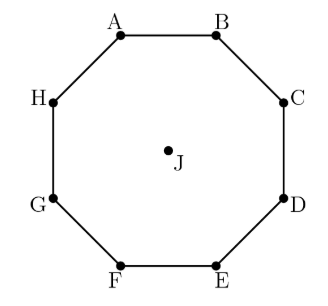
The regular octagon $ABCDEFGH$ has its center at $J$. Each of the vertices and the center are to be associated with one of the digits $1$ through $9$, with each digit used once, in such a way that the sums of the numbers on the lines $AJE$, $BJF$, $CJG$, and $DJH$ are all equal. In how many ways can this be done?
$\textbf{(A)}\ 384 \qquad\textbf{(B)}\ 576 \qquad\textbf{(C)}\ 1152 \qquad\textbf{(D)}\ 1680 \qquad\textbf{(E)}\ 3456$
Due to the symmetry of the arithmetic suite, the central pivot must be a 'symmetry point' of the set—typically the median or the extreme values—to allow the remaining elements to form equidistant pairs.
2015 AMC 10B Problems/Problem 20
Erin the ant starts at a given corner of a cube and crawls along exactly 7 edges in such a way that she visits every corner exactly once and then finds that she is unable to return along an edge to her starting point. How many paths are there meeting these conditions?
$\textbf{(A) }\text{6}\qquad\textbf{(B) }\text{9}\qquad\textbf{(C) }\text{12}\qquad\textbf{(D) }\text{18}\qquad\textbf{(E) }\text{24}$
- 2 Solution 1 (Coloring)) ==what the teacher explains
- 3 Solution 2 (Counting and Optimal Strategy))
- 4 Solution 3 (3D Geometry))
- 5 Solution 4 (3D Geo & Logic))
- 6 Solution 5 (Insight from 2006 AMC 10A Problem 25))
2013 AMC 10A Problems/Problem 24
Central High School is competing against Northern High School in a backgammon match. Each school has three players, and the contest rules require that each player play two games against each of the other school's players. The match takes place in six rounds, with three games played simultaneously in each round. In how many different ways can the match be scheduled?
$\textbf{(A)}\ 540\qquad\textbf{(B)}\ 600\qquad\textbf{(C)}\ 720\qquad\textbf{(D)}\ 810\qquad\textbf{(E)}\ 900$
2016 AMC 10B Problems/Problem 22
A set of teams held a round-robin tournament in which every team played every other team exactly once. Every team won $10$ games and lost $10$ games; there were no ties. How many sets of three teams $\{A, B, C\}$ were there in which $A$ beat $B$, $B$ beat $C$, and $C$ beat $A?$
$\textbf{(A)}\ 385 \qquad \textbf{(B)}\ 665 \qquad \textbf{(C)}\ 945 \qquad \textbf{(D)}\ 1140 \qquad \textbf{(E)}\ 1330$